
Group riding rules: how to never lose a rider
The group riding rules that keep a motorcycle group together: lead and sweep riders, the corner-marker system, group size and a separation plan.
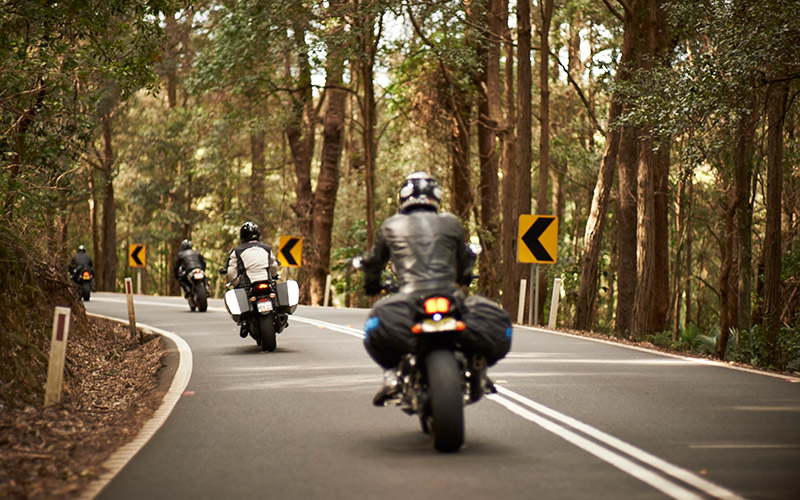
Quick answer: how do you avoid losing riders on a group ride? Assign an experienced lead rider and sweep rider, keep groups to about five to seven bikes, and use the corner-marker system: at every turn, one rider waits and points the way until the sweep arrives. Before the ride, agree that anyone who gets separated stops somewhere safe and waits.
The four group riding rules
- Assign a lead and a sweep. Nobody passes the lead and nobody falls behind the sweep.
- Keep groups to about five to seven bikes. Split bigger groups into sub-groups, each with its own lead and sweep (Motorcycle Safety Foundation).
- Mark every turn. At each junction, one rider waits and points the way until the sweep arrives.
- Agree the separation plan before you start. If you're lost, stop somewhere safe and wait. Don't chase the group.
The group left the city at 6 AM, twelve bikes in a line. By the time they reached the ghat section, the line had turned into three clusters with a few kilometres between each. At a fork where the highway split, the front cluster went left. Nobody was waiting at the fork.
The back cluster went right.
Nobody did anything wrong, exactly. Nobody was reckless and nobody broke a rule. The group just had no system for that fork. That's how most riders get lost: not because of bad riding, but because nobody decided in advance what happens at a junction.
This guide is for anyone who leads, sweeps or organizes group motorcycle rides. It covers the roles, the corner-marker system and the one briefing that prevents most separations.
Why do riders get separated on group rides?
After a lot of rides, we've found separations almost always come from one of four causes:
- Traffic breaks the line. A signal turns red, a truck pulls in, and the group is suddenly in two halves.
- Nobody marks the turn. The front of the group takes an exit, and the back of the group never sees it.
- The group is too big. Twenty bikes in one line stretches over a kilometre. Nobody can see both ends.
- Stops aren't agreed. Half the group stops for fuel at the first pump, and the other half waits at the second.
None of these are about skill. They're process problems, and process problems have process fixes.
What do the lead rider and sweep rider do?
The lead rider
The lead rider sets the pace, knows the route and makes the calls at junctions. The MSF recommends that both the lead and the sweep be experienced riders who know group riding procedures well (MSF Quick Tips: Guide to Group Riding).
A good lead rider:
- Rides to the slowest rider's pace, not their own
- Signals early for turns, stops and hazards
- Checks the mirrors at every junction before moving off
- Never leaves a stop until the sweep has arrived
The sweep rider
The sweep rides at the back. Their job is simple: nobody gets left behind. If a rider stops with a problem, the sweep stops with them. If the sweep hasn't arrived, the group hasn't arrived.
Rider Magazine's guide to group riding recommends the sweep be another highly skilled rider who carries a first-aid kit and tools, and also knows the route in case the group gets separated.
- Lead (front): sets the pace, knows the route and makes the calls at junctions. Carries the route plan and a phone mount.
- Sweep (back): makes sure nobody is left behind. Carries a first-aid kit, basic tools and a puncture kit.
- Corner marker (rotates): points the way at a turn. Needs nothing extra, just patience.
- Newest rider (right behind the lead): rides where the lead can watch them and set the pace.
Putting the least experienced rider right behind the lead is a common recommendation. The lead can see them in the mirror and adjust the pace.
How does the corner-marker system work?
This is the single most useful group-riding habit we know. Some groups call it the "drop-off" or "second-man drop-off" system. Here's how it works:
- At every turn or junction, the rider directly behind the lead stops in a safe, visible spot just after the turn.
- That rider points the way for everyone behind them and waits.
- When the sweep arrives, the corner marker pulls back into the line, just ahead of the sweep.
- The group moves on. At the next turn, the new second rider becomes the marker.
Why it works: nobody has to memorize the route, and nobody has to keep the bike ahead in sight. You only have to reach the next rider waiting at a corner.
A few rules make it work in practice:
- Mark only real decisions. Junctions, forks and exits, not every bend in the road.
- Stop somewhere safe. Past the turn, off the carriageway, visible to riders coming up. Never stop on the inside of a blind corner.
- Don't leave until you see the sweep. Recognize them by their bike, their jacket or a bright vest.
- Adapt to the road. On divided highways where a missed exit means a long U-turn, mark the exit well before it, not at it.
What group size, formation and spacing should you use?
Keep it small. The MSF suggests groups of five to seven riders. Bigger groups should split into sub-groups a few seconds apart, each with its own lead and sweep. Two groups of six stay together much better than one group of twelve.
Stagger on straight roads. In a staggered formation, riders alternate between the two sides of the lane. That gives each rider a clear view ahead and room to move around potholes or debris. The MSF's guideline is about a one-second gap to the rider diagonally ahead and two seconds to the rider directly ahead in your line.
Go single file when it matters. On curvy roads, in poor visibility, on bad surfaces, and when entering or leaving highways, the MSF recommends single file with at least a two-second following distance. Ghat roads, monsoon rain and highway toll plazas all count.
The MSF is a US organization, and its guides assume right-hand traffic. In India, where we ride on the left, mirror the lane positions. The spacing and group-size principles don't change.
What should you do if you get separated from the group?
Even with a good system, separations happen. A puncture, a missed signal or a toll queue can do it. What matters is that everyone already knows what to do.
Agree these four things in the pre-ride briefing:
- If you lose the group, stop somewhere safe and wait. Don't speed up to catch them, and don't guess at a junction.
- The sweep will come to you. Staying on the route means the sweep will find you.
- The next agreed stop is the regroup point. Everyone knows its name, so a lost rider can navigate there alone.
- One person to call. Pick one number, usually the sweep's, not the whole group chat.
The 5-minute pre-ride briefing
The MSF recommends holding a riders' meeting before the ride to cover the route, rest and fuel stops and hand signals, and arriving with a full tank. Here's a briefing you can read out at the meeting point:
Pre-ride briefing (copy this):
- Today's lead is ___. Today's sweep is ___. Don't pass the lead, don't drop behind the sweep.
- We use corner markers. If you're second in line at a turn, you stop and point.
- Stops: ___ (fuel), ___ (breakfast), ___ (regroup). If you get separated, go to the next stop and wait.
- If you're in trouble, call ___. Hazard lights on, pull over safely, and the sweep will stop.
- Signals: here's how we show slow down, stop, fuel and hazard on the road. (Show them. If your group doesn't have its own, the MSF guide has a standard set.)
- Anyone riding with us for the first time? You're right behind the lead.
It takes five minutes. It saves an hour of phone calls.
Can a group ride app keep a group together?
Technology doesn't replace any of the above. An app can't hold a corner, keep formation or slow a rider down. The lead, the sweep and the corner markers are what keep a group together.
What technology can do is take away the guesswork. That's what Wandr, our dedicated motorcycle group ride app for Android, is for. During a trip, riders appear on one live map with smart power saving. When a rider reaches a waypoint, the trip chat shows a notice like "📍 Priya arrived at the breakfast stop." The lead can immediately tell whether a missing rider is 2 km back or took the wrong fork, without making a single phone call. See how Wandr works in 4 simple steps or read why we built Wandr.
It's a second pair of eyes, not a replacement for the first. Check out Wandr's rider safety and emergency tools.
Frequently asked questions
What is the corner-marker system on a group ride?
At each turn, the rider directly behind the lead stops just past the junction and points the way. They wait until the sweep rider arrives, then rejoin the line just ahead of the sweep. Every rider only has to reach the next marker, not memorize the route.
How many riders should be in a motorcycle group?
The Motorcycle Safety Foundation suggests about five to seven riders. Bigger rides should split into sub-groups a few seconds apart, each with its own lead and sweep rider. Smaller groups stay together more easily and are easier for traffic around them to pass.
What should you do if you get separated from your riding group?
Stop somewhere safe and wait, rather than speeding up or guessing at a junction. The sweep rider will come to you. If you know the route, ride to the next agreed stop, which acts as the regroup point, and call the one agreed contact number.
Where should the newest rider ride in a group?
Usually right behind the lead rider. The lead can watch them in the mirror, adjust the pace to suit them and signal hazards early. Putting a new rider at the back means they're the one most likely to get stuck at a red light and lose the group.
The real rule of group riding
A group ride isn't a line of individual riders heading the same way. It's one unit that moves at the pace of its slowest rider and stops for its last one.
Get the roles right, mark the turns and agree the plan before the engines start. You'll find you stop losing riders.
More from this series
- Part 1: Why we built WANDR, a motorcycle group ride app
- Part 3: How to plan a group bike trip: the organizer's checklist: what to send the group a week out, the night before and on the morning
- Part 4: Live location sharing for group rides: what works
P.S. What does your group call the corner-marker system? Tell us in the responses. We'll add the best ones to this guide.
About WANDR: WANDR is an Android app for motorcycle group rides. It combines riding groups, saved route plans with waypoints, turn-by-turn navigation, a live map of every rider and trip chat in one app, and shows when each rider reaches a stop. It's built for riding clubs, ride organizers and friends riding together. Get WANDR on Google Play.
Written by the WANDR team, a group of riders building the tool we wish existed.
Topic tags: group motorcycle rides · motorcycle safety · group riding rules · motorcycle touring · biker community
Your next ride starts with WANDR.
Download free for Android. Keep your crew, your route, and your journey connected on every mile.